Events
Learn more about our future events.
Scientific study
Author
Lars Boesen
Media
Science Direct
Advances in for magnetic resonance imaging (MRI)-guided transperineal biopsy (TPBx) techniques have facilitated outpatient prostate biopsies under local anaesthesia to lower postbiopsy infection rates. However, there is debate regarding antibiotic prophylaxis because of concerns regarding antibiotic resistance and interactions. Our objective was to assess the transition from office-based transrectal biopsy to TPBx performed under local anaesthesia without antibiotic prophylaxis despite potential risk factors for infectious complications.
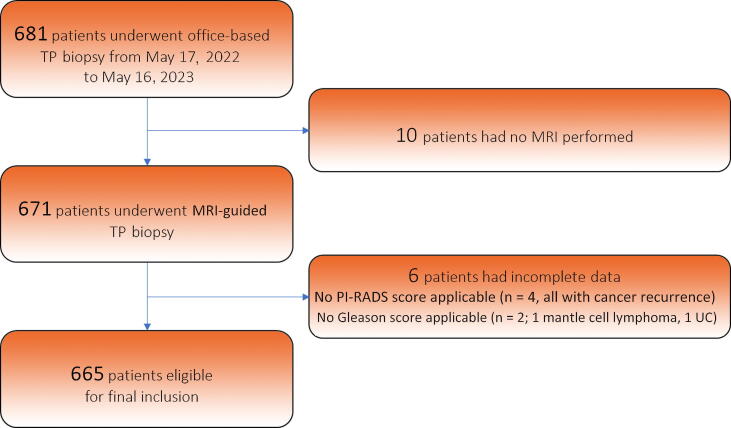
We conducted a prospective assessment of 665 men undergoing office-based MRI-guided TPBx. The primary outcome was the rate of urosepsis or febrile urinary tract infections requiring hospitalisation and/or antibiotics within 2 wk after biopsy. Secondary outcomes included patient-reported procedure tolerability and the prostate cancer detection rate.
TPBx using a median of nine cores per patient (range 4-15) detected prostate cancer in 534/665 men (80%). Only four men (0.6%) were hospitalised for suspected postbiopsy infection; no patient experienced urosepsis. The TPBx procedure was well tolerated, with low pain scores (median Visual Analogue Scale score of 2, interquartile range [IQR] 1-3) and positive patient ratings (median rating 1 [no problem], IQR 1-2). Limitations include the single-centre analysis and lack of randomisation for antibiotic prophylaxis.
An office-based TPBx strategy under local anaesthesia without antibiotic prophylaxis is well tolerated and has a very low risk of side effects. This approach should be considered as the standard of care. Further studies may determine if a subgroup of predisposed men could benefit from antibiotic prophylaxis.